Building a storage bench
Storage benches are extremely practical, as they offer storage space while also providing seating.


Exterior
Interior
Accessories

Glue two of the eight corner supports at right angles to each other. Then screw the boards for the long and short side walls to these. Use a spacer with a thickness of one centimetre. On the left and right sides, screw the two floor supports flush with the bottom edge (picture 2). Place the floor boards on these.
Glue two of the eight corner supports at right angles to each other. Then screw the boards for the long and short side walls to these. Use a spacer with a thickness of one centimetre. On the left and right sides, screw the two floor supports flush with the bottom edge (picture 2). Place the floor boards on these.
Lay out the wooden boards for the top of the lid at regular intervals. Again, you can use the spacer as an aid. Then use the wooden boards for the underside of the lid to secure them and screw them tight.
Screw the hinges firmly to both the lid and the bench. In order to prevent the lid from being tilted backwards, a metal chain is attached. This is fastened with the help of a washer to prevent it from being torn out.
Screw the hinges firmly to both the lid and the bench. In order to prevent the lid from being tilted backwards, a metal chain is attached. This is fastened with the help of a washer to prevent it from being torn out.
Before the bench can be painted, it must be sanded. We recommend 120 grit sandpaper for this. Then use a dust-free microfibre cloth to clean the surface of dust and dirt.
Before the bench can be painted, it must be sanded. We recommend 120 grit sandpaper for this. Then use a dust-free microfibre cloth to clean the surface of dust and dirt.
Cover or mask all surfaces which are not to be sprayed.
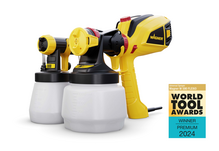
The sprayer is ready for use in just a few steps. Pour paint into the paint container until it is 3/4 full and dilute the material in accordance with the manufacturer's instructions, or depending on the desired spray pattern. To do this, use the included stirrer, each notch corresponding to a 10% dilution. The suction pipe can be aligned depending on how you are going to work - backwards when spraying objects overhead and forwards when spraying downwards. The spray jet can also be adjusted three ways - horizontally, vertically and diagonally. Carry out a test spray to find the right settings for you.
The sprayer is ready for use in just a few steps. Pour paint into the paint container until it is 3/4 full and dilute the material in accordance with the manufacturer's instructions, or depending on the desired spray pattern. To do this, use the included stirrer, each notch corresponding to a 10% dilution. The suction pipe can be aligned depending on how you are going to work - backwards when spraying objects overhead and forwards when spraying downwards. The spray jet can also be adjusted three ways - horizontally, vertically and diagonally. Carry out a test spray to find the right settings for you.
Start with corners, edges and angles and then spray the surfaces. Spray from the outside with a uniform distance over the slats. Only change the direction of spray outside the slats. This avoids a build-up of thicker layers of paint during direction changes.
Tip: since paint applied too thickly can cause drips, it's better to spray two thin coats rather than one thick coat. After spraying, allow the paint to dry in accordance with the manufacturer's instructions.
Start with corners, edges and angles and then spray the surfaces. Spray from the outside with a uniform distance over the slats. Only change the direction of spray outside the slats. This avoids a build-up of thicker layers of paint during direction changes.
Tip: since paint applied too thickly can cause drips, it's better to spray two thin coats rather than one thick coat. After spraying, allow the paint to dry in accordance with the manufacturer's instructions.
Clean the spray attachment thoroughly with water or solvent after use. To do so, unscrew all parts and clean them in a basin by hand or using a sponge.
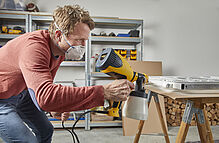
Learn here how best to proceed when spraying varnish, what you should look out for, why it's worth spraying varnishes and what the best equipment is for it.
Spraying varnishes