Building a coat rack
In just a few steps, build a modern coat rack with lots of storage. Bring colour to your hallway and make keeping everything tidy simplicity itself.


Purchase the materials from the enclosed list. The “Lack TV bench” which can be purchased from IKEA is positioned upright with 2 x 2 supporting strips for the inlay shelves (left image). It is best to purchase the door panel with the longitudinal cut already made. Otherwise this can also be made using a mitre saw with traction device, since the guard ensures a right-angled cut. Smooth the edges with sandpaper). The door panel can be enhanced with decorative grooves if desired.
Purchase the materials from the enclosed list. The “Lack TV bench” which can be purchased from IKEA is positioned upright with 2 x 2 supporting strips for the inlay shelves (left image). It is best to purchase the door panel with the longitudinal cut already made. Otherwise this can also be made using a mitre saw with traction device, since the guard ensures a right-angled cut. Smooth the edges with sandpaper). The door panel can be enhanced with decorative grooves if desired.
Open the the paint tin in the required colour using the included stirrer and align the suction pipe on the spray attachment so it is facing forwards. Fill paint up to the 3/4 mark on the paint container and dilute it. Place the stirrer against the base of the filled paint container. The distance between the notches represents a dilution of 10%. Stir the paint well and carry out a test spray. The spray nozzle can be positioned in three different directions. A horizontal jet to work from top to bottom, vertical for right to left or selective for particularly intricate areas. The small dial on the trigger allows the volume of paint to be fully adjusted.
To ensure that the paint adheres well, lightly sand the bench. Start with corners, edges and angles and then spray the surfaces. Spray from the outside with a uniform distance over the boards. Only change the spraying direction when you are past the edge of the spraying surface. This avoids a build-up of thicker layers of paint during direction changes. Tip: Since paint applied too thickly can cause drips, it is better to spray two thin coats. After spraying, allow the paint to dry in accordance with the manufacturer's instructions. Clean the spray attachment thoroughly with water or solvent after use.
To ensure that the paint adheres well, lightly sand the bench. Start with corners, edges and angles and then spray the surfaces. Spray from the outside with a uniform distance over the boards. Only change the spraying direction when you are past the edge of the spraying surface. This avoids a build-up of thicker layers of paint during direction changes. Tip: Since paint applied too thickly can cause drips, it is better to spray two thin coats. After spraying, allow the paint to dry in accordance with the manufacturer's instructions. Clean the spray attachment thoroughly with water or solvent after use.
Screw the base (1100 x 450 mm) together (left image) and paint it white. Put double-sided adhesive tape on the base and stick it horizontally onto the base (the distances from the wall must be taken into account too).
Screw the base (1100 x 450 mm) together (left image) and paint it white. Put double-sided adhesive tape on the base and stick it horizontally onto the base (the distances from the wall must be taken into account too).
Two boards placed behind each other are used for the hat rack. To create the vertical element, lay out a board and determine the distance with the allowance for the aluminium bracket.
Screw a piano hinge for the door (20 mm) along the entire height. Set the TV bench upright and secure in place with carriage bolts and washers.
Screw a piano hinge for the door (20 mm) along the entire height. Set the TV bench upright and secure in place with carriage bolts and washers.
20 x 20 mm angle trims that are shortened with an angle grinder to a length of 500 mm are used for the shelf supports (left image). The holes for fastening the shelf in place are marked with a spirit level then pre-drilled then secured dowels and screws. Insert the coat rack pole and boards (right image).
20 x 20 mm angle trims that are shortened with an angle grinder to a length of 500 mm are used for the shelf supports (left image). The holes for fastening the shelf in place are marked with a spirit level then pre-drilled then secured dowels and screws. Insert the coat rack pole and boards (right image).
Attach the magnetic catch and handle for the door.
The compact spray system for paint and varnish
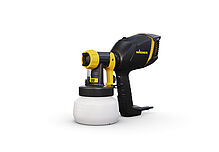
The compact spray system for paint and varnish
W 150
Learn here how best to proceed when spraying varnish, what you should look out for, why it's worth spraying varnishes and what the best equipment is for it.