Zum Hauptinhalt springen Zur Suche springen Zur Hauptnavigation springen

Fly the flag and get out the colours

Is there anything better than enjoying an evening of soccer with friends? So why not organise a barbecue? For a weatherproof seating area for football fans, all you need is a few decorations and a garden bench in your national colours! So you can cheer on your team and enjoy the European Championship 2024 to the full.

Almost everyone has a garden bench at home. With a little colour, you are guaranteed to transform it into an atmospheric highlight for your soccer garden party. We'll show you how easy it is to paint your beer bench.

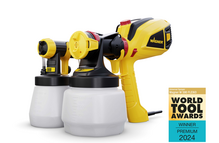
For this project, you need the following items:

  • Paint sprayer for paints and varnishes, e.g. W 590 FLEXiO
  • Sanding machine or block
  • 2 trestles as a base if necessary
  • 1 additional Wood&Metal spray attachment if necessary
  • Masking fleece / newspaper
  • Adhesive tape
  • Sandpaper
  • Beer bench set
  • Acrylic lacquer or weatherproof lacquer in black
  • Acrylic lacquer or weather protection lacquer in red
  • Acrylic lacquer or weather protection lacquer in yellow 
  • For solvent-based paint, suitable solvent for thinning and cleaning

Step-by-step instructions for painting a beer bench set

Step 1: Sanding the set

Schritt 1

Obtain the materials listed in the appendix. Make sure that the bench trim is not treated or varnished. If it is, sand the varnished trim. To do this, use a sander or work with sandpaper and a hand sanding block. Check that the metal feet are not rusty and that the paint is not peeling. If necessary, remove loose paint and rust spots with a wire brush. Wipe all surfaces with a clean microfibre cloth; they should be dry and free from dust and grease.

Step 2: Masquage du cadre

Schritt 2

If the load-bearing metal frame is in good condition, cover the table and bench legs well with masking material (masking paper and tape) to protect anything that is not to be painted (go on to step 3). If the base is to be painted, start by carefully covering the wooden surfaces. Depending on the topcoat used, it may be useful to apply a first coat of primer (follow the manufacturer's instructions). The procedure for spraying is described below.

Schritt 3

If the load-bearing metal frame is in good condition, cover the table and bench legs well with masking material (masking paper and tape) to protect anything that is not to be painted (go on to step 3). If the base is to be painted, start by carefully covering the wooden surfaces. Depending on the topcoat used, it may be useful to apply a first coat of primer (follow the manufacturer's instructions). The procedure for spraying is described below.

Step 3: Preparing the spraying process

Schritt 4

Mix the paint vigorously and dilute it according to the manufacturer's instructions - acrylic paint with water, solvent-based weathering paint with the appropriate solvent.
To do this, place the stirring rod at the bottom of the filled paint can. The distance between the notches represents a 10% dilution. Stir the paint vigorously. 

Schritt 5

Mix the paint vigorously and dilute it according to the manufacturer's instructions - acrylic paint with water, solvent-based weathering paint with the appropriate solvent.
To do this, place the stirring rod at the bottom of the filled paint can. The distance between the notches represents a 10% dilution. Stir the paint vigorously. 

Schritt 6

Mix the paint vigorously and dilute it according to the manufacturer's instructions - acrylic paint with water, solvent-based weathering paint with the appropriate solvent.
To do this, place the stirring rod at the bottom of the filled paint can. The distance between the notches represents a 10% dilution. Stir the paint vigorously. 

Step 4: The spraying process

Schritt 9

Place something under the work area to protect it, such as a protective cloth or newspaper. Start with the corners, edges and angles, then spray the surfaces. Spray from the outside at a uniform distance beyond the panel. Only change the direction of spraying outside the surface. This avoids thicker layers of paint when changing direction. Tip: as too thick a coat of varnish can cause a ‘nose’ to form, it is better to spray twice thinly rather than once too thickly. Allow the varnish to dry after spraying. Clean the spray nozzle thoroughly with water or solvent after use. Proceed in the same way as for the first spray. 

As an alternative to intermediate cleaning, you can use another spray nozzle - available as an accessory from DIY shops.

The result

Universal Sprayer W 590 FLEXiO

Universal Sprayer W 590 FLEXiO

The flexible hand spray gun for indoor and outdoor use

Product
WAGNER product finder

WAGNER product finder

Here you can find more products

Paint spray systems
Why spraying is better

Why spraying is better

With HVLP paint sprayers you have a clear time advantage compared to brushes and rollers.

Why it's better to spray