Zum Hauptinhalt springen Zur Suche springen Zur Hauptnavigation springen

DIY shop: Simple building instructions to build yourself

Step-by-step instructions for a self-built children's shop

"What would you like?" Playing shop is one of the most popular role-playing games for toddlers. Children between the ages of 3 and 6 in particular love to slip into different roles and playfully imitate the everyday life of adults.

A DIY shop is the perfect basis for this: While the game initially consists of short dialogues, it becomes more and more creative, structured and complex as it progresses. At the same time, children develop language, imagination, social behaviour and their first understanding of numbers.

If we want to support children in their development, it makes sense to choose or build toys that reflect the adult world in a child-friendly way. For example, a shop, a children's kitchen, a workbench or a mud kitchen.

In this DIY shop, we show you step by step how you can build a children's shop including accessories yourself. Simple to implement, suitable for everyday use and with plenty of room for creative play.

You need for your shop:

  • Mouth and nose protection
  • Protective gloves
  • Compasses
  • Pencil
  • Ruler or folding rule
  • Screw clamps
  • Wooden folding trestles or stable work surface
  • Screws (suitable for the wood thickness)
  • Large masking film or painter's fleece

Wooden boards (dimensions in cm):

  • Treadmill checkout: 132 × 15 × 2
  • Kitchen worktop: 107 × 30.5 × 2
  • Working or levelling surface: 109 × 30 × 2
  • Oven shelf: 33.5 × 25 × 2
  • Rear panel: 120 × 49.5 × 2
  • Side panel: 105 × 40 × 2

Further materials:

  • 4 Wooden crates with partition wall
  • 2 Wooden crates with door
  • Logs (for the checkout conveyor)
  • Wooden slats (to stabilise the crates)
  • Floor support
  • Fleece or robust textile (for the cash register tape)
  • Lacquer, glaze or wood preservative (suitable for children, saliva-proof)

Optional (for decoration & extras):

  • Chalkboard or blackboard foil
  • Hooks and small shelves
  • Felt glides (as hob plates)
  • Thin wooden discs (for control knobs)

Step-by-step guide to building a shop for your children

Step 1 from 10: Prepare wooden crates

Woman sanding a wooden crate with a sander

The first step in your DIY shop is to prepare the wooden crates. Sand all boxes carefully inside and out so that there are no splinters or rough spots. Then screw wooden strips to the undersides of the boxes to make it easier to open the doors. If necessary, cut the mouldings to the right length beforehand, sand the cut edges smooth and then screw them neatly to the boxes.

Step 2 from 10: Prepare the kitchen worktop and sink

Woman saws a circle out of a wooden board with a handsaw

Now prepare the kitchen worktop for the future sink. First measure the diameter of the washbasin bowl. Then use a pair of compasses to draw a slightly smaller circle (approx. 2 cm) on the plate at the desired point so that the bowl does not slip through the opening later. Saw out the circle with a jigsaw and sand the cut edge thoroughly smooth. You can then insert the washbasin bowl into the opening.

Woman inserts a wash bowl into a sawed-out hole

Now prepare the kitchen worktop for the future sink. First measure the diameter of the washbasin bowl. Then use a pair of compasses to draw a slightly smaller circle (approx. 2 cm) on the plate at the desired point so that the bowl does not slip through the opening later. Saw out the circle with a jigsaw and sand the cut edge thoroughly smooth. You can then insert the washbasin bowl into the opening.

Step 3 from 10: Building your first shop module

Kitchen worktop is clamped onto 2 boxes with screw clamps

For the first module you need two crates, one with a door and one open. Place the two boxes next to each other with some distance between them. Place the prepared kitchen worktop on both boxes, align them and secure them with screw clamps. Then screw the panel to the boxes from the inside. Make sure that the panel is flush with the crate on one side, while leaving a small overhang on the other side for the later connection to the other module. You can add shelves to the boxes for more storage space. Simply screw two squared timbers on the left and right and place the shelf on top.

Kitchen worktop is screwed together with fruit crates

For the first module you need two crates, one with a door and one open. Place the two boxes next to each other with some distance between them. Place the prepared kitchen worktop on both boxes, align them and secure them with screw clamps. Then screw the panel to the boxes from the inside. Make sure that the panel is flush with the crate on one side, while leaving a small overhang on the other side for the later connection to the other module. You can add shelves to the boxes for more storage space. Simply screw two squared timbers on the left and right and place the shelf on top.

Step 4 from 10: Building a second shop module

3 Fruit crates are placed next to each other and the table top is screwed onto them

The sales area of the shop is created from the second module. 
For the second module, place three crates next to each other. There is a crate with a door in the centre, with an open crate to the right and left. Screw the boxes together from the inside on the sides to create a stable module.
Sand the table top thoroughly, place it on the crate module and then screw it to the crates from the inside. Here too, the panel should be flush on one side. 

Step 5 from 10: Prepare connecting element

Man drills into a wooden board with a Forster drill

To connect the two crate modules together, you now build the checkout conveyor. You will need two side boards and a wider board as a work surface. Sand all boards thoroughly. Then drill a hole in one of the two side boards with a Forstner bit and transfer the position precisely to the other board. Drill a hole in the centre of the second board up to half of the board. You can insert the floor support here later. Now drill an opening for the floor support in the round timber. Drill a hole in each end of the second round timber and insert a shelf support on both sides.

Man and boy drilling a hole in a log with a drill

To connect the two crate modules together, you now build the checkout conveyor. You will need two side boards and a wider board as a work surface. Sand all boards thoroughly. Then drill a hole in one of the two side boards with a Forstner bit and transfer the position precisely to the other board. Drill a hole in the centre of the second board up to half of the board. You can insert the floor support here later. Now drill an opening for the floor support in the round timber. Drill a hole in each end of the second round timber and insert a shelf support on both sides.

A floor support is inserted in a round timber

To connect the two crate modules together, you now build the checkout conveyor. You will need two side boards and a wider board as a work surface. Sand all boards thoroughly. Then drill a hole in one of the two side boards with a Forstner bit and transfer the position precisely to the other board. Drill a hole in the centre of the second board up to half of the board. You can insert the floor support here later. Now drill an opening for the floor support in the round timber. Drill a hole in each end of the second round timber and insert a shelf support on both sides.

Round timber is inserted in connecting element

To connect the two crate modules together, you now build the checkout conveyor. You will need two side boards and a wider board as a work surface. Sand all boards thoroughly. Then drill a hole in one of the two side boards with a Forstner bit and transfer the position precisely to the other board. Drill a hole in the centre of the second board up to half of the board. You can insert the floor support here later. Now drill an opening for the floor support in the round timber. Drill a hole in each end of the second round timber and insert a shelf support on both sides.

Second round timber has been inserted 2 Floor support and lies on connecting element

To connect the two crate modules together, you now build the checkout conveyor. You will need two side boards and a wider board as a work surface. Sand all boards thoroughly. Then drill a hole in one of the two side boards with a Forstner bit and transfer the position precisely to the other board. Drill a hole in the centre of the second board up to half of the board. You can insert the floor support here later. Now drill an opening for the floor support in the round timber. Drill a hole in each end of the second round timber and insert a shelf support on both sides.

Step 6 from 10: Prepare the checkout conveyor belt

Man holds a pencil in one hand and a measuring tool in the other and draws a line on a piece of wood

First determine the position of the two slots through which the cash register belt will later run and mark them on the work surface. Pre-drill a hole at one end of each slot and then saw out the slots with the jigsaw. Carefully sand the cut edges smooth.

Two holes are drilled in a wooden board and lines are drawn on it

First determine the position of the two slots through which the cash register belt will later run and mark them on the work surface. Pre-drill a hole at one end of each slot and then saw out the slots with the jigsaw. Carefully sand the cut edges smooth.

A slot is sawn out of a wooden board

First determine the position of the two slots through which the cash register belt will later run and mark them on the work surface. Pre-drill a hole at one end of each slot and then saw out the slots with the jigsaw. Carefully sand the cut edges smooth.

Step 7 from 10: Fitting the checkout belt

Drill a hole in a wooden board (side element) with a drill

Now drill a hole in each of the two side boards for the second round timber on which the cash register belt will be guided. Insert both round timbers including shelf supports into the side boards. Then screw the two side boards to the sides of the worktop from below so that they are securely fastened. 

Man screws the part of the connecting element with a cordless screwdriver

Now drill a hole in each of the two side boards for the second round timber on which the cash register belt will be guided. Insert both round timbers including shelf supports into the side boards. Then screw the two side boards to the sides of the worktop from below so that they are securely fastened. 

Step 8 from 10: Insert cash register belt

Woman draws a cash register tape on a black tarpaulin

Cut a long strip of fleece or other suitable fabric for the cash register tape. Now feed the fabric strip through the prepared slits from bottom to top on both sides. Pull the fabric taut and glue the ends on the underside with a hot glue gun.

Woman holding a cut-out strip of cash register tape in the air

Cut a long strip of fleece or other suitable fabric for the cash register tape. Now feed the fabric strip through the prepared slits from bottom to top on both sides. Pull the fabric taut and glue the ends on the underside with a hot glue gun.

Woman glues the two ends of the cash register tape strip together using a hot glue gun

Cut a long strip of fleece or other suitable fabric for the cash register tape. Now feed the fabric strip through the prepared slits from bottom to top on both sides. Pull the fabric taut and glue the ends on the underside with a hot glue gun.

Step 9 from 10: Seal the wood

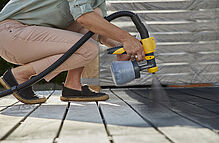
The wooden elements in the garden are sprayed with a paint sprayer

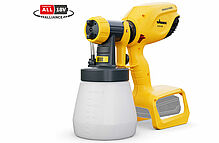
Now that all the modules have been assembled, it's time to seal the children's shop. For an even and clean result, we spray varnish, glaze, wood preservative or paint with a Battery paint sprayer from WAGNER on the wood. Spraying ensures an even surface, even on edges and in corners ... and saves time. Be sure to protect the substrate with a fleece or masking film and work in a well-ventilated area. Then allow the surface to dry completely.

Step 10 from 10: Find a place and decorate

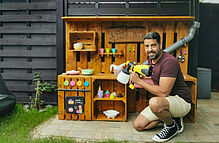
The shop is fully decorated and furnished in the room.

As soon as the paint or wood preservative is completely dry, you can decide on the final location for the children's shop and design it however you like. 

Now equip the children's shop with matching toys - and you're ready to cook, shop and play.

Toy shop: Design ideas

1
2
3
4
5
6
7
8