Zum Hauptinhalt springen Zur Suche springen Zur Hauptnavigation springen

Sandpit with cover and seating - DIY to build yourself

Is your old sandpit getting on in years, a bit dilapidated and in some places the wood is even rotten? Are you looking for a new, functional sandpit that meets the needs of your family and the space in your garden? Preferably with a sturdy wooden cover so that cats and the like don't use the sand as an open-air toilet? Then the DIY pros from the Saris Garage YouTube channel will show you how you can build and install a brand new sandpit yourself with a little skill, the right materials and the right tools.

A step-by-step guide: From the wooden pallet to the sandpit


For the DIY you need:

  • Battery paint spray system W 600 FLEXiO 18V
  • Crowbar
  • Hammer
  • Saw
  • Circular handsaw
  • Sander
  • Stapler
  • 2 Euro pallets
  • Wooden boards
  • Wood stain
  • Optional wooden crates for decoration
  • Hinges
  • Handles
  • Sandpit fleece
  • Safety goggles
  • Work gloves
  • Screws
  • Pencil
  • Ruler
  • Tarpaulin
  • Wooden trestles

Step 1: Prepare the first pallet

sandbox doing 1

The first of the two Euro pallets is now being prepared for its new purpose as a sandpit: Use a crowbar and hammer to carefully remove the center strut and saw off the protruding nails with a hacksaw as close to the wood as possible. Then saw through the middle of the pallet with a circular saw. That worked out well? Then do the same with the second pallet. You should now have four pallet pieces of the same size.

Step 2: Connecting pallets for the sandpit frame

sandbox doing 2

The four cut-to-size pallet parts are now joined together on edge in a square. This construction forms the frame for the future sandpit. You can now screw each side firmly together using two brackets. It is best to always place one on the lowest struts and one in the middle so that they are not in the visible area later.

Step 3: Finishing the sandpit frame

sandbox doing 3

To give the sandpit more stability and to better connect the Euro pallets to each other, a board is cut for each inner side and fastened with many screws. The free space at the outer corners was filled with EPAL blocks cut from leftover material. Fasten the blocks with sufficient screws.

Step 4: Preparing the boards for the sandpit cover

sandbox doing 4

You will need an even number of boards to cover the sandpit. Christian and Sari use 14 boards from old stock for this, but you could also use 12 or 16. Depending on the width of your boards. The two outermost boards are attached directly to the frame of the sandpit.

Step 5: The seats begin

sandbox doing 5

Now the seats are finished on each side. To do this, four slats with the same dimensions as the seat are screwed onto two boards. The distance to the edge should be chosen so that they disappear into the frame later. The four strips are attached to the two boards of the cover with screws at the same distance.

Step 6: Sand the wood and spray on wood protection varnish

sandbox doing 6

What good is the most beautiful sandpit if it is not safe and fades or disintegrates within a very short time? Therefore, as with any other DIY project, professional glazing is the be-all and end-all! So before all the boards, the cover and the seats are put in place, the wood is thoroughly sanded and then sprayed with wood protection varnish.

Your new game changer: The Universal Sprayer W 600

If you don't want to spend hours painting every side of every board with a brush, it's best to use the cordless Universal Sprayer W 600 FLEXiO from WAGNER. Especially great: Thanks to the rechargeable battery, you don't have to rely on cable lengths or even power sockets outdoors, but can spray the sandbox wherever there is space in the garden.

Step 7: Finishing the seats

sandbox doing 7

Two boards were joined together with two strips before glazing. This construction is now turned over on the sandpit frame so that it connects to the already assembled boards and the slats point downwards towards the sand. Position the hinged fittings and secure them with screws. The seats can now be folded up and down.

Step 8: Building the backrest and finishing the sandpit

sandbox doing 8

For the two backrests, first saw off two slats each, which must be longer than the backrest. As they serve as a support to the floor when unfolded, they must be long enough. Once everything has been precisely measured and sawn, these slats are also mounted on the boards for the backrest. It is best to do this in pairs. The sandpit is ready! What a milestone. Now comes the final touches. First, the fleece is stapled to the inside of the wooden frame, then the sandpit is placed in the right spot in the garden and the most important thing: fill it with lots of sand! Now you can play!

The result

A DIY is not enough? Here are some more sandpit ideas:

Not quite sure whether you are confident enough to build a sandpit with a lid and folding seat yourself?
No problem, then maybe our other DIY ideas are something for you.

  • The simplest and probably quickest way to have a sandpit in the garden is the version without a frame. This means you look for a nice spot in the garden and simply pour a large pile of sand on top. The kids will love this sand hill! For them, it's all about digging and building - they don't really care whether the sand stays in place.
  • Is that too messy for you? Then try a sandpit with a frame but without a lid. Classic square, made of untreated wood, in a shady or semi-shady spot. No frills, but still a highlight for the children.
  • Those who are a little more confident can build a sandpit with a roof for their children. Then it doesn't matter whether it's in the shade or not. The roof provides plenty of sun and can be lowered in the evening as a cover.
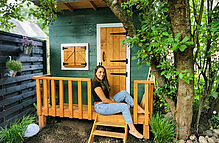
  • The deluxe version of a sandpit is the version in which the sandpit is a small playhouse with an integrated sand drawer. This requires a little more material, skill and patience, but the children's enjoyment of this sensational play area will make up for the many hours of work.
  • Another exciting idea: a sandpit in the shape of a ship or car. The ship's sail or the car roof then serves as sun protection, there can be benches to sit on and this playful look leaves nothing to be desired for any child.
W 600 18V product 01

Universal Sprayer W 600 FLEXiO

You can now apply thick and thin materials quickly and with perfect coverage, without cables: The W 600 FLEXiO 18V cordless paint spraying system allows unlimited freedom of movement when carrying out small and large projects in the home and garden. 

W 600 FLEXiO 18V
playhouse mood5

Build your own playhouse

Have your children been wanting their own playhouse in the garden for a while? Then create a retreat for them where they can plan their next adventure with friends or run wild on a warm summer's day.

To the DIY project
2361507 W100 Indoor ApplicationPicture Close up

Spraying woodstain: Guide & tips

Find out how best to proceed when spraying paint, what you should bear in mind, why it's worth spraying paint and which appliances are suitable.

Spraying varnishes